58 items·United States 28 · Rest of world 30·edition 2026-09-23·UTC
A readingUS regulators start pricing the buildout's costs while markets rally on its promise. A competing reading: The record close is attributed to Iran talks and cheaper oil, not the buildout, and Washington is still underwriting that buildout with 300 gigawatts of planned nuclear while rejecting AI rules.
Top stories
2 items
single source
Image: Microsoft Security Blog
Microsoft disrupts EvilTokens, an AI phishing kit sold on Telegram for $1,500
Microsoft's Digital Crimes Unit, working with partners, facilitated a coordinated disruption of the infrastructure behind EvilTokens, a phishing-as-a-service platform that emerged in February 2026 and compromised more than 12,000 inboxes in over 10,000 organizations worldwide. Microsoft Threat Intelligence tracks the operator behind the kit as Storm-2992.
The kit abuses device code authentication, a legitimate OAuth flow built for devices with limited interfaces such as smart TVs, printers and conferencing devices. Because authentication completes on a separate device, the session is not strongly bound to the user's original context, letting attackers capture tokens and circumvent multifactor authentication without exposing credentials. Stolen tokens support email exfiltration, concealing inbox rules and Microsoft Graph reconnaissance of organizational structure and permissions.
Storm-2992 sold the kit for $1,500 USD upfront plus a $500 monthly subscription, bundling AI-written lures and 44 different themes. Observed victims span wholesale distribution, construction, financial services, real estate, higher education and healthcare, with the highest concentrations in the United States, Canada, the United Kingdom, Australia, India and France. Microsoft recommends blocking device code flow wherever possible.
A reading
US operations are directly exposed: the United States is among the countries with the highest observed victim concentrations, and the remedy Microsoft names is a tenant configuration change American firms must make themselves, blocking device code flow and scoping any Teams device exception through Conditional Access.
ShinyHunters claims FBI breach through unpatched Oracle PeopleSoft zero-day
The ShinyHunters extortion gang told BleepingComputer it breached FBI systems using a new Oracle PeopleSoft zero-day that allows remote code execution and remains unpatched, then moved laterally into FBI-managed AWS GovCloud infrastructure. The group claims it stole between 2TB and 3TB of data covering current and former employees, job applicants, and other internal records. The FBI said it is investigating claims of unauthorized activity affecting FBIjobs.gov but did not confirm whether systems were breached or data taken.
BleepingComputer has not independently verified the zero-day, the lateral movement, or the amount of data stolen. 404 Media, which first reported the alleged breach, said it verified that some information in a sample of approximately 5,000 purported FBI employee records was accurate, including phone numbers tied to US Department of Justice personnel.
ShinyHunters says it is now using the same alleged flaw against other organizations, including Fortune 500 companies, after targeting the education sector, and has given the FBI one week to correct or remove a FLASH report on the group published in May 2026.
A reading
This is a US operations exposure: the attackers say they are already turning the same unpatched PeopleSoft flaw on Fortune 500 companies, so American enterprises running Oracle's HR platform face an actively claimed exploit with no fix available.
Justice Department defends Trump's White House ban on CNN, Politico and MS Now
The Trump administration's Department of Justice argued in a new legal filing that access to the White House is a privilege, not a right, defending the president's ban on CNN, MS Now and Politico ahead of a federal court hearing. The filing asserted the three outlets constituted a national security threat by publishing sensitive or classified information obtained through their reporting.
Trump banned the three outlets last Friday in a snap decision announced via social media, branding them fake news and threatening that bans on other outlets could follow. The outlets filed a joint lawsuit early the following week, asking a federal judge to restore access and alleging illegal retaliation in violation of their First Amendment rights.
Other news organizations have responded in solidarity: several have declined to publish images or video of the president while the ban stands, and the five channels of the president's standard TV pool have ceased their duties. Trump has said he will probably lose the case, which is before a judge he appointed.
A reading
A US federal judge is now weighing whether a president can revoke White House credentials over coverage he dislikes, a First Amendment question that governs the terms on which US news organizations operate in Washington.
Binance invests $100 million in Circle to push USDC beyond its US base
Binance agreed to invest $100 million in stablecoin issuer Circle as part of a five-year deal under which the crypto exchange will promote Circle's flagship USDC on its platform. Binance is buying $100 million of Circle shares at $80.84 each, subject to a lockup of as long as two years, with some exceptions. Circle shares rose more than 1% in premarket trading Tuesday.
The agreement gives USDC access to Binance's large global user base in exchange for Circle paying Binance a monthly incentive fee tied to USDC balances. Circle has been building a business beyond issuing USDC, launching its Arc blockchain last week and pushing into nanopayments and agentic commerce, but still needs USDC to drive that expansion.
Tether's USDT remains the larger stablecoin according to CryptoQuant, and a strong international trading presence. USDC has built its pitch around regulated markets, transparency and payments.
A reading
For the US market, Circle — the issuer that listed on the New York Stock Exchange and built USDC on regulated-market credibility and a historically U.S.-focused base — is now paying a recurring fee tied to USDC balances to buy offshore distribution.
V7 turns company files into agent memory, with GPT-6 Astra at 89% on hardest queries
OpenAI published a customer story on V7, a Europe and UK startup whose V7 Go platform organizes company documents into a Context Graph that agents can query. On a new set of graph-query questions built from messier, real-world data across thousands of documents, V7 reports GPT-6 Astra scored 89% accuracy on the very-hard level.
V7 Go maps steps to model tiers: GPT-a significant figure Luna handles high-volume extraction at a a significant figure lower cost per document than GPT-5.4 mini, while GPT-a significant figure Terra or Sol carry reasoning and tool use, where Sol cut the tool-call error rate from 2.7% with GPT-5.5 to 0.2%. Reported customer results include asset managers screening deals 21x faster, a full-day process reduced to 15 minutes; a financial services team cutting review from more than 100 hours to under 10 and saving $12,000 in expert costs per task; and insurance teams reducing claims-processing errors by 13.5% against a manual baseline.
Rizzoli argues that the finance firms getting real value from AI will be the ones with the best context, not the most agents.
A reading
The consequence the article supports is operational rather than regulatory — that gains in document-heavy finance and insurance review come from structuring a firm's own records into queryable, source-linked context rather than deploying more agents — and it reports no US-specific market or regulatory effect, since V7 is described as a Europe and UK company.
Ethiopian Airlines Suspends Flights to Three Tigray Destinations After Airport Seizure
Ethiopian Airlines suspended flights to three destinations in Tigray, following reports that forces affiliated with the Tigray People's Liberation Front had taken control of the airport in the regional capital.
The suspension underscores renewed tensions in northern Ethiopia. Those tensions followed the TPLF retaking control of the regional administration and rejecting an interim government appointed by Prime Minister Abiy Ahmed.
A reading
The article supports no United States market, regulatory or operational consequence; it establishes only that a national carrier has halted service to three Tigray destinations amid a contested regional administration in northern Ethiopia.
Fed Governor Barr signals at least two more rate hikes are likely this year
Federal Reserve Governor Michael Barr said on Wednesday that the central bank took an important step last week to recalibrate short-term borrowing costs, and that further interest rate hikes will likely be needed. In prepared remarks for a Chicago Fed housing affordability conference, he said risks to reaching the inflation target have increased while risks to the labor market have receded, and that inflation remains above the Fed's 2% goal without heading clearly downward.
The comments follow a unanimous decision last week to raise the policy rate to the range, after which policymakers signaled at least one more hike before year end. Barr's remarks suggest he expects at least two more, though he gave no timing, a specificity that contrasts with Chairman Kevin Warsh's refusal to offer forward guidance on the rate path.
Most of Barr's speech addressed housing affordability, worsened by scarce supply and high mortgage rates. The average US 30-year fixed-rate mortgage rose to 7.12% last week, more than a two-year high.
A reading
US borrowing costs look set to keep climbing rather than plateau, with the 30-year fixed mortgage already at 7.12% and a Fed governor pointing to at least two further hikes — a direct squeeze on US housing demand and on any domestic business planning around credit.
Nasdaq 100 Hits First Record Since June as Trump Signals Progress in Iran Talks
US equity futures wavered after the Nasdaq 100 closed at its first record high since June, a move fueled by AI enthusiasm. President Trump said US envoys had held very good talks with Iranian officials in New York.
Tehran was reported to have held firm positions on the reopening of the Strait of Hormuz, leaving the two sides apart on that point even as Trump characterized the discussions positively. Separately, Chinese President Xi Jinping is heading to Washington for a summit at the White House, with many US tech executives expected to attend.
Stefano Scarpetta of the OECD discussed the organization's latest economic forecast on Bloomberg Brief, and Katrina Dudley of Franklin Templeton gave her view on the tech rally and her outlook for equities.
A reading
The consequence is operational for US companies with energy and China exposure: Tehran's firm stance leaves the Strait of Hormuz reopening unresolved despite the New York talks, while the White House summit puts many US tech executives in the room for the Xi meeting.
DoorDash agrees to pay $131.5m over New York City delivery wage violations
DoorDash agreed to pay a $131.5m (£99m) settlement to New York City regulators after admitting it failed to compensate thousands of workers correctly or on time. The agreement with the Department of Consumer and Worker Protection follows a city investigation into wage violations.
The majority of the settlement, $83m, resolves a disagreement over how to calculate pay for the time workers spend online between deliveries. Apps traditionally paid drivers only during active deliveries, but New York's rules require compensation for all time logged into the app. DoorDash blamed complex changes to New York state's minimum wage introduced in 2023, under which wages differ by county, tipping and how many people work for the employer, along with technical glitches and multi-stop delivery routes.
The company said the errors hit roughly 264,000 workers while insisting the issues affected under 1% of overall local transactions. Around $6.6m in wages never reached workers and another $5.7m arrived days or weeks late. DoorDash said it has patched the software bugs responsible.
A reading
For US operations, a city regulator has now put a nine-figure price on idle-time pay, making compensation for every hour a worker is logged into an app an enforceable cost in New York City for platforms that have repeatedly clashed with municipal officials over minimum wages and tipping rules.
U.S. trade deficit widened to $88.6 billion in July on surging computer imports
The U.S. goods and services deficit was $88.6 billion in July, up $17.4 billion from a revised $71.2 billion in June, the Census Bureau and the Bureau of Economic Analysis reported. Exports were $310.7 billion, $6.6 billion less than in June, while imports were $399.3 billion, $10.8 billion more.
The move came from goods. The goods deficit widened $17.6 billion to $119.6 billion, while the services surplus rose $0.2 billion to $31.0 billion. Imports of capital goods increased $14.4 billion, with computers up $6.9 billion, computer accessories up $6.6 billion and semiconductors up $1.2 billion. Exports of industrial supplies and materials fell $8.7 billion, including crude oil down $4.5 billion and nonmonetary gold down $3.9 billion.
Year-to-date, the deficit is still down $188.4 billion, or 29.6 percent, from the same period in 2025, with exports up 12.0 percent and imports up 1.9 percent. The deficit with Mexico increased $7.2 billion to $27.5 billion.
A reading
These trade statistics feed directly into BEA's National Economic Accounts, including GDP, so a $17.4 billion one-month widening concentrated in computer and computer-accessory imports enters U.S. growth measurement immediately, even as the year-to-date deficit remains 29.6 percent below 2025.
Real consumer spending rose in 48 states in 2023, BEA says, with Alabama the exception
Real personal consumption expenditures by state increased in 48 states and the District of Columbia in 2023, the U.S. Bureau of Economic Analysis reported, with the percent change ranging from 7.3 percent in Maine to –0.6 percent in Alabama. Real personal income increased in 46 states and the District of Columbia, ranging from 6.0 percent in Vermont to –2.0 percent in Iowa.
Nationally, real PCE increased 2.5 percent while current-dollar PCE increased 6.4 percent, and real personal income increased 2.1 percent against a 5.9 percent rise in current-dollar personal income. The national PCE price index increased 3.8 percent. Regional price change accounts for the outliers: Alabama's current-dollar PCE increased 5.5 percent while its implicit regional price deflator increased 6.1 percent, and Iowa's current-dollar personal income increased 2.2 percent against a deflator increase of 4.3 percent.
Price levels remain far apart across states. California had the highest regional price parity, at 112.6, and Arkansas the lowest, at 86.5; for housing rents, California was highest at 157.8 and Mississippi lowest at 54.9.
A reading
For US operations, the same payroll dollar buys materially different amounts by location — California's regional price parity of 112.6 against Arkansas at 86.5, and housing rents at 157.8 in California versus 54.9 in Mississippi — which is the measurable cost gap behind siting and compensation decisions.
CFTC staff advisory restricts listing of 'mention market' event contracts
The Commodity Futures Trading Commission's Division of Market Oversight issued an advisory on September 22, 2026 addressing the listing and trading of event contracts that settle on whether an individual will say or "mention" certain words, attend or appear at an event, or otherwise interact with another person.
Staff identified these contract types as presenting a heightened risk of manipulation, because settlement turns on the discrete conduct of a person that may be neither independently generated nor externally verifiable. The advisory outlines the limited circumstances in which such contracts may be listed consistently with the Commodity Exchange Act and Commission regulations, and provides non-exhaustive examples of factors designated contract markets should consider when designing.
It also reminds DCMs of their obligation under Core Principle 3 to list only contracts that are not readily susceptible to manipulation, and emphasizes complete, contract-specific analysis in Part 40 submissions. The release points to CFTC Staff Letter No. 26-27.
A reading
This is a US regulatory constraint: exchanges listing event contracts in the United States now face stated staff expectations that mention market products clear Core Principle 3 and carry contract-specific manipulation analysis in their Part 40 submissions, narrowing what they can put on the board.
FTC and Washington State Extract $225 Million From Amway in Largest MLM Action
Amway Corp., one of the largest multilevel marketing companies in the U.S., and two affiliates — World Wide Group and Leadership Team Development — will pay $225 million to resolve Federal Trade Commission and Washington state allegations that they used unfair and deceptive tactics to recruit members. The FTC described it as the largest monetary recovery ever obtained in an agency action against a multilevel marketing company, with nearly all of it going to redress for harmed consumers.
The joint complaint alleges the companies told recruits, called Independent Business Owners, that they were likely to earn substantial income exceeding $40,000 a year, when most who joined through the two affiliate groups after 2020 spent more on Amway products and training than they received. It also alleges IBOs were instructed to buy set monthly amounts regardless of whether they could resell them, and to falsely report sales they had not made.
The proposed order requires IBOs to sell at least 70% of the products they buy from Amway each month and substantially reduces recruiter compensation.
A reading
This is a US regulatory consequence: the FTC has set a $225 million recovery benchmark and written structural conditions into the order — a 70% resale requirement and cut recruiter pay — that US direct-selling and multilevel marketing operators will now be measured against.
FTC settles with Nuvei for $4.85 million over payment processing for tech support scams
Global payment processor Nuvei will pay $4.85 million to settle Federal Trade Commission charges that it opened and maintained payment processing accounts for merchants it knew or should have known were engaged in deception. The FTC alleges that Nuvei and its subsidiaries processed more than $30 million in consumer payments for Reimage, an offshore tech support scam, from 2017 to 2023.
According to the complaint, Nuvei used a merchant acquiring bank registered in Cyprus to furnish Reimage and other overseas schemes with accounts that let them take credit card payments from cardholders in the United States and elsewhere. Its U.S.-based subsidiary, Nuvei Technologies Inc., allegedly served merchants selling business opportunities with baseless earnings claims, merchants impersonating government tax authorities, and merchants other processors or acquiring banks had already terminated for excessive chargebacks or fraud.
The proposed order bans Nuvei from serving tech support telemarketers and pop-up sellers, prohibits tactics used to evade bank and card network fraud monitoring such as load balancing, and requires screening and monitoring of existing and prospective clients. The Commission vote was 2-0.
A reading
This is a US regulatory consequence for payments operations: the FTC is charging the processor itself under the FTC Act and the Telemarketing Sales Rule for the merchants it onboards — following its earlier case against processor Paddle — and the order turns merchant screening and enhanced review of high-chargeback clients into court-enforced obligations.
Venezuela's Rodríguez meets Trump in New York after 65bn-barrel oil deal
Venezuela's interim president, Delcy Rodríguez, met Donald Trump late on Tuesday at the Lotte New York Palace hotel in Manhattan, on the sidelines of the UN general assembly. A White House aide said the secretary of state, Marco Rubio, and the deputy chief of staff Stephen Miller also attended. Rodríguez said afterwards that the two discussed strengthening bilateral ties and a cooperation agenda covering energy, mining and security.
The meeting followed months of concessions since US special forces seized Nicolás Maduro in January. Rodríguez has ceded control of Venezuela's oil revenues to Washington and agreed to a 65bn-barrel oil deal that Trump on Tuesday called the largest oil deal in history. Trump has praised her leadership while sidelining the opposition leader María Corina Machado, and appears more focused on access to Venezuela's natural resources than on a fresh presidential election.
It was the first meeting between US and Venezuelan presidents since 2015. Brazil's president, Luiz Inácio Lula da Silva, used his UN address to reject external interference in the region and called for fresh elections in Venezuela.
A reading
The consequence is for US energy operations: the article says Venezuela has ceded control of its oil revenues to Washington and agreed to a 65bn-barrel deal, so US access to those reserves now runs through a working relationship with Rodríguez rather than through any change of government in Caracas.
Foreign Policy columnist argues Trump breaks Machiavelli's rules for holding power
Foreign Policy columnist Stephen M. Walt, a Harvard professor, argued on September 23, 2026 that President Donald Trump is the poster child for how to be a very bad prince, taking off from a Paul Krugman post noting that other countries are rapidly losing their fear of Trump and joining forces to push back.
Walt writes that Trump's ability to threaten and intimidate has been undermined by blunders such as the war with Iran, leaving counterparties little reason to reach an agreement he might tear up months later. Leaders such as Xi Jinping have taken advantage of it, and the corporate leaders, university presidents and law firms that bent the knee early in his second term now look craven and foolish.
On fiscal matters, Walt calls Trump a chronic spendthrift and the first president to offer to pay Americans to vote for his party by promising them a $5,000 check, which he says would be illegal and would increase the deficit. The bond market and Machiavelli agree, Walt writes, that such a lack of fiscal discipline is unwise.
A reading
For US operations, the article's claim is that the calculus of accommodating the White House has inverted: the corporate leaders, university presidents and law firms that bent the knee early in Trump's second term now look craven and foolish, while those who stood up to him look courageous and farsighted.
Microsoft disrupts EvilTokens, an AI phishing kit sold on Telegram for $1,500
Microsoft's Digital Crimes Unit, working with partners, facilitated a coordinated disruption of the infrastructure behind EvilTokens, a phishing-as-a-service platform that emerged in February 2026 and compromised more than 12,000 inboxes in over 10,000 organizations worldwide. Microsoft Threat Intelligence tracks the operator behind the kit as Storm-2992.
The kit abuses device code authentication, a legitimate OAuth flow built for devices with limited interfaces such as smart TVs, printers and conferencing devices. Because authentication completes on a separate device, the session is not strongly bound to the user's original context, letting attackers capture tokens and circumvent multifactor authentication without exposing credentials. Stolen tokens support email exfiltration, concealing inbox rules and Microsoft Graph reconnaissance of organizational structure and permissions.
Storm-2992 sold the kit for $1,500 USD upfront plus a $500 monthly subscription, bundling AI-written lures and 44 different themes. Observed victims span wholesale distribution, construction, financial services, real estate, higher education and healthcare, with the highest concentrations in the United States, Canada, the United Kingdom, Australia, India and France. Microsoft recommends blocking device code flow wherever possible.
A reading
US operations are directly exposed: the United States is among the countries with the highest observed victim concentrations, and the remedy Microsoft names is a tenant configuration change American firms must make themselves, blocking device code flow and scoping any Teams device exception through Conditional Access.
ShinyHunters claims FBI breach through unpatched Oracle PeopleSoft zero-day
The ShinyHunters extortion gang told BleepingComputer it breached FBI systems using a new Oracle PeopleSoft zero-day that allows remote code execution and remains unpatched, then moved laterally into FBI-managed AWS GovCloud infrastructure. The group claims it stole between 2TB and 3TB of data covering current and former employees, job applicants, and other internal records. The FBI said it is investigating claims of unauthorized activity affecting FBIjobs.gov but did not confirm whether systems were breached or data taken.
BleepingComputer has not independently verified the zero-day, the lateral movement, or the amount of data stolen. 404 Media, which first reported the alleged breach, said it verified that some information in a sample of approximately 5,000 purported FBI employee records was accurate, including phone numbers tied to US Department of Justice personnel.
ShinyHunters says it is now using the same alleged flaw against other organizations, including Fortune 500 companies, after targeting the education sector, and has given the FBI one week to correct or remove a FLASH report on the group published in May 2026.
A reading
This is a US operations exposure: the attackers say they are already turning the same unpatched PeopleSoft flaw on Fortune 500 companies, so American enterprises running Oracle's HR platform face an actively claimed exploit with no fix available.
CISA flags a 7.8-severity flaw across Siemens SIMATIC and SIPLUS control products
CISA published ICS advisory ICSA-26-265-04 on September 22, 2026, covering Siemens SIPLUS and SIMATIC products affected by the "Copy Fail" vulnerability. The issue is tracked as CVE-2026-31431, rated 7.8 under CVSS v3, and classified as Incorrect Resource Transfer Between Spheres.
The affected list runs across the SIMATIC and SIPLUS human-machine interface panel families, SIMATIC AX Runtime Core builds, the CN 4100, the IoT2050 Advanced, the IPC Industrial Edge Device OS and the S7-1500 TM MFP module. Siemens has released new versions for several affected products and recommends updating to the latest versions. For products where fixes are not, or not yet, available, Siemens is preparing further fix versions and recommends specific countermeasures.
CISA lists the equipment as deployed worldwide and names the exposed critical infrastructure sectors as Critical Manufacturing, Energy, Water and Wastewater Systems, Chemical, Food and Agriculture, and Commercial Facilities. Siemens is headquartered in Germany.
A reading
This is an operations consequence: US plants and utilities in the sectors CISA names must now either update the affected Siemens panels and controllers or apply Siemens' interim countermeasures on the units whose fixes have not shipped yet.
Advocates press UN for universal clean energy access by 2030 as fossil politics revives
A group of leading advocates will deliver a letter to the UN this week, during the annual gathering of climate experts in New York, urging faster action and setting one goal: clean energy access for everyone, everywhere by 2030. Signatories include Bernie Sanders, Laurence Tubiana, Yeb Saño, Kumi Naidoo, Jane Fonda and Danny Kennedy of the Global Solar Council. A giant mural near the High Line in New York City will carry the same three-word demand.
The letter lands in a weak political moment: the host superpower is pursuing oily energy dominance, Canada's Mark Carney is building new oil and gas pipelines, and Britain, which purged coal power from its energy system last year, appears poised to start new North Sea drilling.
The counterweight is deployment. Solar panels are going up faster than any energy source has ever grown; China appears to have begun cutting emissions, and California has cut the use of gas to produce electricity in half in the world's fourth-largest economy. China and India are using barely half their solar panel factory capacity.
A reading
The split runs through the US market itself: California has cut the use of gas to produce electricity in half in the world's fourth-largest economy while the federal government pursues oil-led energy dominance, leaving US energy buyers and generators facing opposite policy signals at state and national level.
Newsom signs seven bills shifting California data center grid and water costs
California Gov. Gavin Newsom on Monday signed seven bills giving communities more information about proposed data centers' energy, water, workforce and land use. The laws require data centers to pay their fair share of grid update costs, disclose water use to local governments and give up blanket environmental exemptions, according to the governor's office.
SB 1168 directs the California Public Utilities Commission to ensure data centers pay for transmission and distribution upgrades and load increases. SB 886 and SB 887 require data centers to pay all infrastructure upgrade and generation costs, bear a larger share of wildfire mitigation and liability costs, and undergo environmental review. AB 1577 requires monthly reporting of energy consumption and efficiency metrics to the California Energy Commission, while AB 2469 and AB 2619 require water supply assessments and statewide water reporting.
California is home to 296 data centers, the number in the U.S., according to Data Center Map. The laws follow Los Angeles County's planning director ordering a temporary ban on development of large-scale AI data centers in unincorporated areas.
A reading
This is a US regulatory shift: in the state with the number of data centers in the country, developers must now absorb transmission, distribution and generation upgrade costs, take on a larger share of wildfire mitigation and liability, file water supply assessments and report energy use monthly, raising the cost and permitting burden of siting AI capacity in California.
Sesame Workshop brings Elmo and child climate research to New York Climate Week
At a New York Climate Week event named "Big Storms, Big Feelings", the Sesame Street character Elmo recounted his fear when a storm hit Sesame Street, an event depicted in a recent episode that featured the singer Post Malone. He described having a go bag ready and said residents banded together to clean up the neighborhood afterwards.
Kim Foulds, vice-president of research and insight at Sesame Workshop, said the show is looking for avenues for children to talk about the climate crisis, and cited a study of how children make sense of extreme weather and how their parents navigate those events across a global, diverse context. Parents reported alarm over extreme weather, and children gave accounts of severe heat and flooding. Foulds said the biggest disruption to young children is to their routines, including inability to go to school and lost time outside, and that extreme heat came up across all geographies.
The event came as media and political focus on the climate crisis has waned despite recent disasters.
A reading
The concrete read for US executives is operational rather than regulatory: Sesame Workshop, a US children's media producer, is building extreme-weather storylines and parent-facing research into its franchise, repositioning climate as children's programming at a moment when media and political attention to the issue has waned.
Public companies are 2% of US oil and gas producers but 68% of Lower 48 output
The U.S. Energy Information Administration reported on September 22, 2026 that publicly traded companies accounted for just 2% of about 12,000 oil and natural gas producers in the United States in 2025, yet produced 68% of the crude oil and natural gas in the Lower 48 states.
That concentration comes as output heads to records. EIA forecasts U.S. crude oil production will average 13.8 million barrels per day in 2026, surpassing the previous record of 13.7 million barrels per day set in 2025, and marketed natural gas production will average 122.5 billion cubic feet per day in 2026, above the 118.5 billion cubic feet per day record set in 2025.
EIA attributes rising Permian output to operators drilling longer horizontal wells in western Texas and eastern New Mexico, including super-lateral wells that exceed 15,000 feet. U.S. LNG exports averaged 17.4 billion cubic feet per day in the first six months of the year, 23% more than the same period in 2025.
A reading
For the US market, most Lower 48 crude oil and natural gas supply now comes from the 2% of producers that are publicly traded, so a small set of listed companies' output decisions set domestic supply even as EIA forecasts record 2026 production.
Study links about 40% of Western snowpack decline to 122 carbon major companies
A peer-reviewed study published August 25 in Communications Earth & Environment found that climate change over the past 70 years has cut annual average mountain snowpack in the Western United States by 36%, and that about 40% of that decline is linked to 122 oil, gas, coal, and cement producers and state-owned operations. The annual loss attributable to those companies equals the water Lake Mead holds at full capacity.
The nine authors, from the University of California at Merced and the Union of Concerned Scientists, also recorded a 13% decline in average annual streamflows and a 4.3% increase in irrigation demand, attributing roughly half of each to the same 122 firms — a 6% fall in streamflows traced to their products.
New York and Vermont have passed climate superfund laws requiring the biggest historical emitters to help pay for climate damages; New York's was struck down in court and the state plans to appeal. California is among states considering similar bills, and several states are suing major fossil fuel companies. Chevron and ExxonMobil did not respond to questions.
A reading
This is a US regulatory exposure story: the study supplies states such as New York, Vermont, and California with quantified attribution figures for the climate superfund laws and damages suits they are already pursuing against major fossil fuel producers.
Wright tells IAEA the U.S. aims to add 300 gigawatts of nuclear capacity by 2050
Energy Secretary Chris Wright delivered the U.S. National Statement at the 70th IAEA General Conference in Vienna on September 14, 2026, laying out an American nuclear expansion agenda.
Wright said the administration is modernizing regulations, improving processes, streamlining advanced reactor testing and setting standards for converting surplus uranium and plutonium into reactor fuel, in support of the goal of adding 300 gigawatts of new nuclear capacity in the United States by 2050. He tied that energy infrastructure to American reindustrialization and artificial intelligence. The Department of Energy's advanced reactor pilot program, aimed at deploying small modular reactors, has led to five distinct reactors achieving criticality in rapid succession, with the operational data and regulatory insights intended to inform future commercial reactor technologies.
Wright also pointed to interest among countries in the Convention on Supplementary Compensation for Nuclear Damage, which he described as a key step to unlocking project financing and facilitating civil nuclear cooperation.
A reading
This is a US regulatory signal: the federal government is building an expedited pathway for testing and approving advanced reactors and setting fuel-conversion standards, changing the permitting environment for anyone planning US generation capacity for reindustrialization or AI load.
Bernstein lifts its prediction-market forecast to $10 trillion a year by 2035
Bernstein now projects prediction markets will handle $10 trillion a year in trading volume by 2035, roughly 24 times the $410 billion it expects the industry to process this year and 10 times its own $1 trillion by 2030 forecast, issued in April. Analysts led by Gautam Chhugani told clients volumes should compound at roughly 70% a year through 2035, after industry-wide trading grew from about $50 billion in 2025 to roughly $300 billion in the first eight months of 2026.
The bank expects the mix to invert. Contracts on crypto, stocks and commodities rise from 12% of volume in 2025 to 49% by 2035, becoming the largest category for the first time, while sports falls from 61% to 38%. Kalshi controls about 60% of industry volume, up from 35% a year ago, and Robinhood's event-contract revenue jumped tenfold in the second quarter of 2026.
Bernstein said firm U.S. regulatory clarity for sports prediction markets is unlikely before 2027 or 2028, citing conflicting court rulings over whether the contracts are federally regulated derivatives or state-regulated gambling.
A reading
This is a US regulatory exposure: Bernstein expects no settled federal answer on whether sports prediction contracts are derivatives or state-regulated gambling before 2027 or 2028, so US venues such as Kalshi and Robinhood keep scaling event-contract volume and revenue under unresolved rules.
CME Group Plans Bitcoin Cash and Uniswap Futures for October 19 Launch
CME Group said Tuesday it plans to launch Bitcoin Cash and Uniswap futures on October 19, pending regulatory review, in both standard and micro contract sizes. Bitcoin Cash futures will represent 250 BCH, with micro contracts covering 25 BCH, while Uniswap futures will cover 10,000 UNI and micros will trade at 1,000 UNI.
The listings extend a pattern of altcoin rollouts this year. Cardano, Chainlink and Stellar contracts came in February, and Avalanche and Sui futures launched May 4. CME said that 2026 push has generated more than $1 billion in total notional value year-to-date.
Across the full crypto complex, CME's futures and options averaged 279,800 contracts daily in the first half of 2026. CME's global head of cryptocurrency products said maturing crypto markets require broader regulated tools for digital asset price risk. BCH and UNI would become the tenth and eleventh single-asset crypto futures products.
A reading
This is a US regulatory story: the October 19 launch is contingent on regulatory review, and clearance would widen the menu of tokens US institutions can hedge inside a regulated, cleared futures venue rather than offshore.
Horowitz Andreessen Academy raises $42 million for a degree-free San Francisco school
The Horowitz Andreessen Academy, a for-profit school backed by venture-capital firm Andreessen Horowitz, has raised $42 million and opened applications for a full-time, in-person program in San Francisco aimed primarily at recent high-school graduates. Its first offering, the Founding Class Fellowship, is a one-year program scheduled to begin in September 2027 with about 50 students.
The academy is not accredited and will not initially award degrees or grant college credit, trading lecture-heavy coursework for independent projects, short classes and structured work placements. The founding class is tuition-free, and participants receive more than $50,000 in computing credits and a $5,000 travel and research budget, though they must pay for their own housing, meals and living expenses. A two-year paid program is intended for 2028, subject to regulatory approval, with tuition comparable to that of an elite private university.
Ten founding partners, including OpenAI, Google, Meta, Nvidia, Palantir and Anduril, will help shape the curriculum, while a broader group of hiring partners may consider students for internships and full-time roles.
A reading
For US operations, several of the largest American technology employers are helping design an unaccredited, degree-free talent pipeline they can recruit from directly, with hiring partners positioned to take students into internships and full-time roles.
McDonald's commits $8.5 billion over 10 years to restaurant tech and training
McDonald's unveiled McDonald's Next on Wednesday, a plan to spend $8.5 billion over the next 10 years on its restaurants. The plan adds more technology in stores, new training for employees, and aims to increase the chain's market share of chicken menu items and beverages.
The move comes as McDonald's reported slowing comparable sales growth in its most recent quarter, which it attributed to trouble rolling out a new value menu of items costing $3 or less. The company gave no details on prices or on fixing that menu, and no answer for customers who once went to the Golden Arches for a cheap, quick meal and now go to Burger King or Chili's.
McDonald's said AI and other operational improvements will raise cash flow per restaurant by about $100,000 annually, and that it aims to gain 1.5 percentage points of share in both beverages and chicken by 2030 while maintaining its burger share.
A reading
For US operations, McDonald's is putting a decade of capital behind in-store technology and training rather than price, leaving unanswered the value-menu problem that has been sending its cheap-meal customers to Burger King and Chili's.
Scope3 rebrands as Apostra and pivots to agent-to-agent ad buying
Brian O'Kelley and cofounder Anne Coghlan are renaming their company Scope3 to Apostra, repositioning it as a platform connecting advertisers' AI agents with agents representing media sellers, so marketers do not have to build separate integrations with potentially thousands of publishers and platforms.
The platform uses AdCP, a protocol created last year by a consortium including Scope3, and the company says it works with 40 media partners and has built adapters for Google, Meta, Amazon, Reddit and ChatGPT Ads. It is already running seven-figure campaigns; O'Kelley said an unnamed major brand began with a $1 million US campaign in April before expanding into other markets and channels. Apostra charges no transaction fees or percentage of media spend, selling add-on intelligence capabilities instead.
Scope3 had raised $60 million in total, and two rounds of layoffs cut head count from over 100 staffers to about 40 people. O'Kelley said the company expects to seek additional funding between now and the middle of next year.
A reading
For the US advertising market, Apostra targets the buying plumbing American brands rely on — it routes deals through agents rather than real-time bidding and takes no cut of media spend, and a major brand has already run a $1 million US campaign through it, though the article notes adoption may be slowed by large brands' procurement processes and by relationship-driven dealmaking such as the annual US TV upfronts.
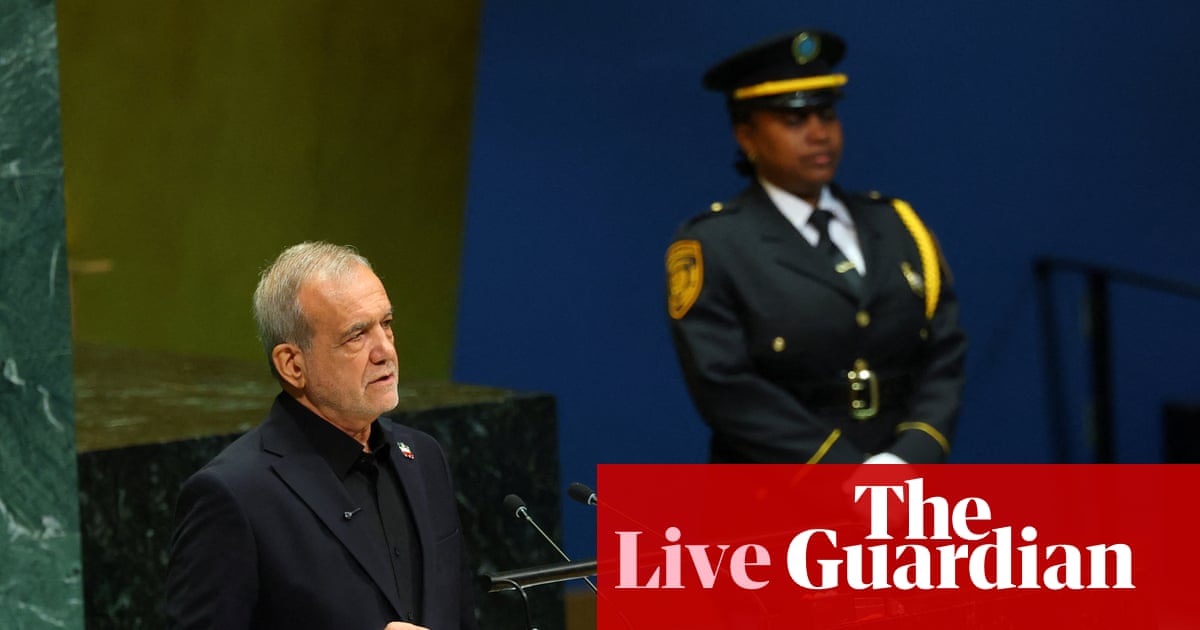
Pezeshkian invokes Strait of Hormuz access as US delegation walks out at UN
Iran's president Masoud Pezeshkian addressed the 81st United Nations General Assembly on Wednesday and responded angrily to Donald Trump's speech of the previous day, rejecting the description of Iranians as terrorists and saying Iranians had been the victims of terrorism. The US delegation walked out as he spoke, leaving the US and Israeli seats empty.
On the Strait of Hormuz, Pezeshkian argued that others should not enjoy free access to a waterway and profit from it while using that same waterway to impose aggression and insecurity on Iran and to deny Iran access to its own waterways. He warned that an expansion of warfare would not produce security. On the nuclear question he said Iran sought the technology for energy and progress rather than military use, and would accept no limitation on peaceful nuclear technology.
He said sanctions, pressure and bullying would only harden Iranian resistance, and that Iran was ready for dialogue, diplomacy and negotiations but not on terms set by force.
A reading
Iran has now publicly tied its grievance over sanctions and military pressure to access through the Strait of Hormuz, and did so at a session the US delegation walked out of, leaving a dispute over a major waterway and a nuclear programme aired in public with no negotiating channel on show.
Canadian province sues OpenAI over role in mass shooting
A Canadian province has sued OpenAI over the company's role in a mass shooting, the Financial Times reported on 22 September 2026.
A reading
A provincial government is taking an AI developer to court over a mass shooting, putting the question of model makers' liability for real-world harm before a Canadian court.
Diesel surge adds €30 per tank for European drivers
Diesel prices have surged in Europe, leaving drivers paying €30 more to fill a tank, the Financial Times reported on 23 September 2026.
Across the region, the higher pump prices cost European drivers €203mn per day.
A reading
Diesel at this level takes €203mn a day out of European pockets, a continent-wide drag on household spending power and on the cost of moving goods by road.
Check Point patches management server zero-day used in targeted attacks since July
Check Point said attackers exploited a previously unknown flaw in its Security Management Server in a handful of targeted attacks on July 23, and released a fix on September 22. The bug, CVE-2026-93616, is a path traversal flaw in the server's web service that lets an attacker able to reach that service upload scripts and run them without logging in. Check Point rated it 9.8 out of 10 on the CVSS scale.
The affected server controls firewall policies for the Check Point gateways it manages. The company's advisory does not name the targets of the July attacks or the attackers, nor say what the attackers did after exploiting the flaw, and installing the fix does not show whether a server was attacked before.
Separately, Check Point said attackers have been trying since September 12 to exploit a VPN flaw it fixed on September 9, tracked as CVE-2026-85102, targeting customers of Spark, its firewall line for small businesses.
A reading
The compromised system is the one that sets firewall policy for every gateway beneath it, and it was being exploited two months before a fix existed, so organisations running it cannot tell from patching alone whether their network control plane was already taken.
Paramount settles with US states, clearing a final hurdle to $110bn Warner Bros merger
Paramount Skydance has settled a lawsuit with a dozen US states, clearing one of the final hurdles for its $110bn (£82.8bn) merger with Warner Bros Discovery.
Under the agreement, Paramount must release at least 30 films each year, with guardrails against AI-generated films, and ensure 20% of all film production takes place in the US for the first two years. If it misses the quota, it must sell its stake in Miramax. Paramount has also promised a news editorial independence board over CBS News and CNN, and a separate settlement with the Writers Guild of America requires a payment into the guild's health fund and bars writer layoffs at CBS News Broadcast for five years.
California Attorney General Rob Bonta said the agreement was not a vote of support for the merger, and that keeping the merged company's headquarters in California is not part of the deal. The guild, which settled because it could not afford to fight alone, still believes the merger will damage writers and the industry.
A reading
A $110bn combination of legacy studios, major streamers and national networks reshapes the supply side of the global content market, and shows competition authorities pricing clearance in binding production quotas, divestiture triggers and editorial governance rather than cash.
Canadian province sues OpenAI over role in mass shooting
A Canadian province has sued OpenAI over the company's role in a mass shooting, the Financial Times reported on 22 September 2026.
A reading
A provincial government is taking an AI developer to court over a mass shooting, putting the question of model makers' liability for real-world harm before a Canadian court.
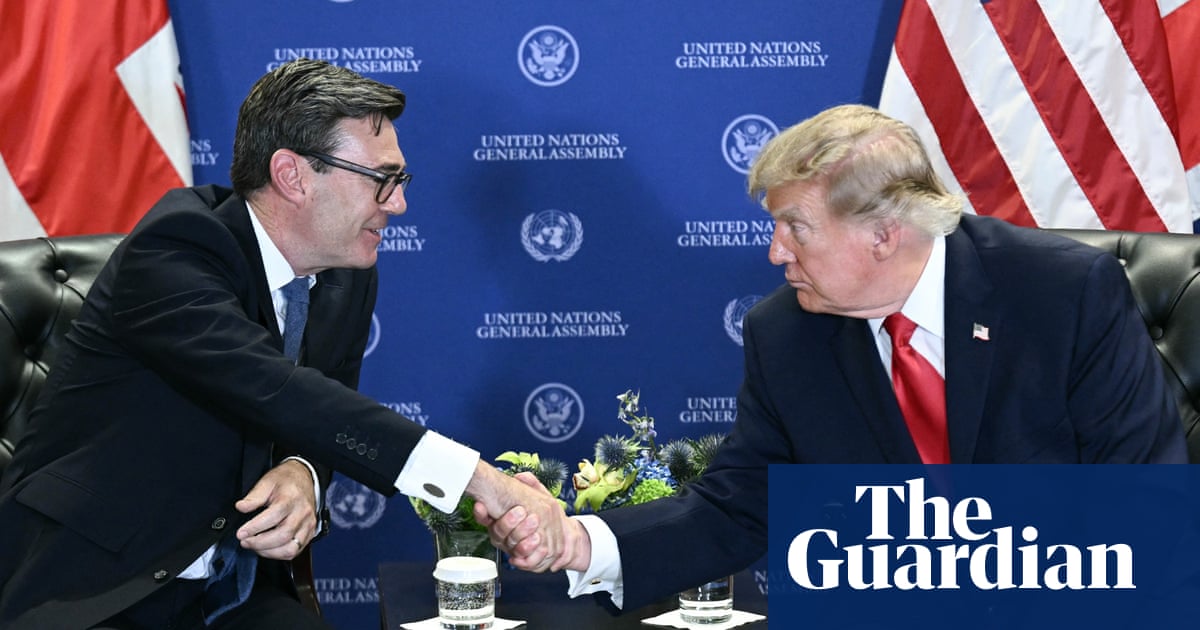
Trump rejects global AI rules as Burnham seeks shared standards at UN meeting
Donald Trump and Andy Burnham met face to face for the first time at the UN General Assembly in New York, where the US president praised the UK prime minister even as the two sides remained split over artificial intelligence regulation, the Chagos Islands and the war in Iran.
Trump said the United States rejects any attempt to build a globalist scheme to control AI and would encourage the technology rather than rein it in, having previously dismissed warnings about its existential threat as a hoax. Burnham told business leaders he wants a single set of global principles and standards against rogue AI, a main focus of the UK's G20 presidency next year. He is also under pressure to join a Finland- and Norway-led initiative, backed by more than 20 countries, barring AI companies from launching models commercially without prior safety testing.
Burnham had said he would press for de-escalation in Iran, with Middle East turmoil pushing up global energy prices and straining the UK economy; Trump said prices would fall once the war ended.
A reading
Companies deploying AI across borders now face an openly divergent rulebook, with the US rejecting international control while more than 20 countries and the UK's G20 presidency next year push toward mandatory pre-launch safety testing.
OpenAI extends its Daybreak cyber program to Ukraine's government for civilian defense
OpenAI announced on September 23, 2026 that it will offer the Government of Ukraine access to its Daybreak program to support the cyber defense of civilian infrastructure. Working with the Ministry of Digital Transformation, it will give Ukrainian teams tools to identify software vulnerabilities and to develop and test fixes more quickly. The announcement was made on the sidelines of the UN General Assembly by Ukraine's Consul General in San Francisco and OpenAI's Head of National Security Policy.
Ukrainian defenders face persistent cyber attacks from Russia alongside physical attacks on the country's infrastructure. CERT-UA, the national cyber incident response team, handled nearly 6,000 cyber incidents in 2025, including attacks on hospital systems, the energy sector and telecommunications.
The move extends an existing pattern. OpenAI has already provided cyber model access to defenders in Europe including France, Germany and Poland. ENISA used the models to identify vulnerabilities in software used across EU institutions, all since fixed, and CERT Polska used them to help discover six vulnerabilities in third-party router software, for which the vendor has released fixes.
A reading
A commercial AI vendor is becoming part of the cyber defense stack of governments and EU agencies, turning model access into an instrument of national infrastructure resilience rather than an ordinary procurement decision.
Basecamp Research raises $140 million from Nvidia and Anthropic's Anthology Fund
London-based Basecamp Research has raised $140 million from investors including Nvidia and Anthropic's Anthology Fund, with S32 leading the round; the NATO Innovation Fund and Redalpine also took part. Founded, the company trains AI models called EDEN on genetic material collected from rainforests, oceans and hot springs to design antibiotics and tools for cell therapies.
The sampling network now spans more than 30 countries and all seven continents. The first EDEN generation trained on 9.7 trillion DNA building blocks from more than a million newly sequenced species; the dataset held about 15 trillion tokens at the time of the interview and is meant to grow roughly a hundredfold over the next year and a half. Basecamp argues public databases are too narrow: about 68 percent of the sequence volume in the Sequence Read Archive comes from just five species.
Evidence so far is preclinical. A candidate called EDEN-7 reportedly worked about as well as a last-resort antibiotic in mice infected with multidrug-resistant bacteria; human clinical trials still have to prove the therapies are safe and effective.
A reading
Frontier AI investors are now funding genomic data collection across more than 30 countries and all seven continents, moving the raw material for drug-discovery models into habitats that public genome databases barely cover.
Oil price on track for longest losing streak in more than 12 months
The oil price is on track for its longest losing streak in more than 12 months, according to the Financial Times.
The article text is not available beyond that statement: the body sits behind a subscription paywall, so no figures, dates or drivers for the decline are given in the source.
A reading
A run of declines this long in crude is a global price signal, weighing on oil-exporting economies while easing input costs for importers.
Diesel surge adds €30 per tank for European drivers
Diesel prices have surged in Europe, leaving drivers paying €30 more to fill a tank, the Financial Times reported on 23 September 2026.
Across the region, the higher pump prices cost European drivers €203mn per day.
A reading
Diesel at this level takes €203mn a day out of European pockets, a continent-wide drag on household spending power and on the cost of moving goods by road.
Revolut and Nubank go head to head in a bid to crack the US banking market
The Financial Times reports that Revolut and Nubank, rivals in digital banking, are competing directly as each tries to break into the US banking market.
The article's contents are behind a paywall, so no further detail on either bank's approach, timing or progress is available from the source.
A reading
Two rival digital banks are pursuing the same expansion market at the same time, so the contest decides which of them establishes a US foothold first.
ECB to invest part of own funds in tokenised securities, settled through Pontes
The European Central Bank said on 21 September 2026 that it has launched preparatory work to invest part of its own funds in tokenised securities, with the stated aim of gaining practical experience with such investments and with distributed ledger technology.
The resulting transactions are to be settled in central bank money in Pontes, the Eurosystem's settlement solution for DLT transactions.
The initial investments are to focus on euro-denominated euro area public sector and European supranational securities.
A reading
A euro area central bank is moving tokenised settlement from experiment to its own balance sheet, using central bank money rather than private settlement assets.
Paramount settles with US states, clearing a final hurdle to $110bn Warner Bros merger
Paramount Skydance has settled a lawsuit with a dozen US states, clearing one of the final hurdles for its $110bn (£82.8bn) merger with Warner Bros Discovery.
Under the agreement, Paramount must release at least 30 films each year, with guardrails against AI-generated films, and ensure 20% of all film production takes place in the US for the first two years. If it misses the quota, it must sell its stake in Miramax. Paramount has also promised a news editorial independence board over CBS News and CNN, and a separate settlement with the Writers Guild of America requires a payment into the guild's health fund and bars writer layoffs at CBS News Broadcast for five years.
California Attorney General Rob Bonta said the agreement was not a vote of support for the merger, and that keeping the merged company's headquarters in California is not part of the deal. The guild, which settled because it could not afford to fight alone, still believes the merger will damage writers and the industry.
A reading
A $110bn combination of legacy studios, major streamers and national networks reshapes the supply side of the global content market, and shows competition authorities pricing clearance in binding production quotas, divestiture triggers and editorial governance rather than cash.
Trump pushes 'super intelligence' rebrand for AI as experts doubt it sticks
US President Donald Trump told the United Nations General Assembly on Tuesday that the term artificial intelligence makes the technology sound fake, and said it should be called super intelligence, or SI. He said all United States documents, and hopefully the world's, would switch to the term, which won polls he ran on his Truth Social platform.
Experts told the BBC the label is unlikely to gain traction in the industry because it typically describes more advanced systems. A digital ethics lecturer at the University of Melbourne called the rebranding misleading and doubted it would stick, saying it exaggerates current capacities; the idea, linked to philosopher Nick Bostrom, remains entirely hypothetical. Other academics said researchers reserve the term for a much bigger leap.
Allies including the US chief technology officer and the ambassador to the UN adopted it, while Canada's AI minister said Canadians are not enthusiastic about renaming things. Trump, who has dismissed warnings about AI as a hoax and opposes regulating the technology, is set to meet Xi Jinping this week, with AI expected to be discussed.
A reading
A US push to relabel the technology that the president wants the rest of the world to adopt, which researchers call misleading and Canada has already brushed off, lands days before Trump meets Xi Jinping with AI expected on the agenda.
UK air chief says GPS disruption would cost the economy £1.4 billion every day
The UK's Chief of the Air Staff, Air Chief Marshal Sir Harv Smyth, used the opening keynote of the UK Space Power Conference on 23 September 2026 to argue that space is now a warfighting domain in its own right. He noted that the RAF headquarters at RAF High Wycombe transitioned to become Air and Space Command a few weeks ago.
In May, the UK tracked unusual and significant manoeuvres by 5 Russian military satellites moving to within rapid reach of two finished commercial satellites. In June, it was confirmed that a Russian satellite constellation had disrupted GPS signals across Europe, Greenland and Canada over at least 75 days since 2019.
Major disruption to GPS would cost the UK economy £1.4 billion of impact every day, he said, hitting sat-nav, the timing signals behind financial transactions and Earth observation, and leaving every sector less efficient, less prosperous and less secure. He recalled that NATO policy treats attacks to, from or within space as a threat that could trigger Article 5.
A reading
The satellite positioning and timing layer that quietly underpins navigation, financial transactions and weather monitoring is now being described by a NATO air chief as actively contested, with a stated exposure of £1.4 billion of impact every day if it fails.
Central Arbitration Committee refreshes its applications and complaints page again
The Central Arbitration Committee updated its GOV.UK news story on how to submit applications and complaints to the committee on 23 September 2026. The page was first published on 17 March 2020 and describes the submission of applications and complaints to the CAC.
The update history logs the change only as a news article, the same wording used for the revisions dated 16 September 2026, 15 September 2026, 7 September 2026 and 2 September 2026. The page carries no detail of what was changed on any of those dates.
The story is published on GOV.UK under Work and is issued by the Central Arbitration Committee, the body listed as its source.
A reading
Businesses with matters before the United Kingdom's Central Arbitration Committee are working from a submissions page that changed again on 23 September 2026 without the notice stating what changed.
Britain names seven Historic England commissioners from property, finance and culture
The UK's Department for Digital, Culture, Media and Sport has appointed seven commissioners to Historic England: Charles Donald, Dominic Field, Anna Keay, Georgina Lynch, Claire McColgan, Lukman Patel and Moira Sinclair. Each serves from 1 October 2026 to 30 September 2030.
The cohort leans commercial and civic. Donald has almost 40 years across investment banking and public sector finance and was Chief Executive of UK Government Investments from 2020 to January 2026. Lynch is Managing Director of the PJ Livesey Group, a developer that converts former hospitals, mills and schools into housing. Patel, Chief Executive of Burnley Borough Council, has secured investment for the restoration and reuse of listed buildings. They join Keay, who oversees the Landmark Trust's estate of more than 200 historic properties, Field, who spent a 20 year career at Boston Consulting Group, McColgan, Liverpool's culture and major events director, and Sinclair, Chair of Factory International.
Commissioners are remunerated at £4,133 per year. The appointments were made under the Governance Code on Public Appointments, and none of the seven declared significant political activity.
A reading
For anyone investing in or developing historic property in England, the next four years of heritage oversight sit with a board weighted toward public finance, commercial reuse and local-authority regeneration rather than conservation expertise alone.
Altman, Amodei and Delangue to brief an emergency UN Security Council meeting
Artificial intelligence, the US-Israeli war in Iran and climate change are set to dominate the second day of the 81st UN General Assembly session, where tech industry leaders Sam Altman of OpenAI, Dario Amodei of Anthropic and Clement Delangue of Hugging Face will brief an emergency meeting of the 15-member UN Security Council.
The session runs September 22-28, 2026, against a backdrop of global conflicts, environmental crisis and massive technical disruption. Wednesday's speakers include Syria's Ahmed al-Sharaa, who said his country's reconstruction was gathering pace, and Iran's Masoud Pezeshkian, who told the chamber Iranians had been the victims of terrorism rather than terrorists. On the sidelines, US Secretary of State Marco Rubio met his Russian counterpart Sergei Lavrov, after the Kremlin said there were no prerequisites for moving onto a peaceful negotiating track in Ukraine.
The same 15-member council is itself under challenge: the foreign ministers of Brazil, Germany, India and Japan called its reform more necessary than ever, in a body where the vetoes of the five permanent members often keep resolutions from being carried out.
A reading
Frontier AI has reached the agenda of the UN's top security body at the same moment that body's own members are calling its structure unworkable, so any global rules for the technology would be negotiated in a forum where a single permanent member can block them.
Pezeshkian invokes Strait of Hormuz access as US delegation walks out at UN
Iran's president Masoud Pezeshkian addressed the 81st United Nations General Assembly on Wednesday and responded angrily to Donald Trump's speech of the previous day, rejecting the description of Iranians as terrorists and saying Iranians had been the victims of terrorism. The US delegation walked out as he spoke, leaving the US and Israeli seats empty.
On the Strait of Hormuz, Pezeshkian argued that others should not enjoy free access to a waterway and profit from it while using that same waterway to impose aggression and insecurity on Iran and to deny Iran access to its own waterways. He warned that an expansion of warfare would not produce security. On the nuclear question he said Iran sought the technology for energy and progress rather than military use, and would accept no limitation on peaceful nuclear technology.
He said sanctions, pressure and bullying would only harden Iranian resistance, and that Iran was ready for dialogue, diplomacy and negotiations but not on terms set by force.
A reading
Iran has now publicly tied its grievance over sanctions and military pressure to access through the Strait of Hormuz, and did so at a session the US delegation walked out of, leaving a dispute over a major waterway and a nuclear programme aired in public with no negotiating channel on show.
Check Point patches management server zero-day used in targeted attacks since July
Check Point said attackers exploited a previously unknown flaw in its Security Management Server in a handful of targeted attacks on July 23, and released a fix on September 22. The bug, CVE-2026-93616, is a path traversal flaw in the server's web service that lets an attacker able to reach that service upload scripts and run them without logging in. Check Point rated it 9.8 out of 10 on the CVSS scale.
The affected server controls firewall policies for the Check Point gateways it manages. The company's advisory does not name the targets of the July attacks or the attackers, nor say what the attackers did after exploiting the flaw, and installing the fix does not show whether a server was attacked before.
Separately, Check Point said attackers have been trying since September 12 to exploit a VPN flaw it fixed on September 9, tracked as CVE-2026-85102, targeting customers of Spark, its firewall line for small businesses.
A reading
The compromised system is the one that sets firewall policy for every gateway beneath it, and it was being exploited two months before a fix existed, so organisations running it cannot tell from patching alone whether their network control plane was already taken.
Researcher shows Meta's Muse assistant can be turned into a backdoor on Macs
Security researcher Patrick Wardle released a proof-of-concept on September 21 showing that malware already running on a Mac can quietly take over Meta's Muse assistant. It works by changing an undocumented preference, endo_voyager_dictation_endpoint, so that dictated prompts go to the attacker rather than to Meta.
Muse is the personal AI agent Meta launched this month in the United States, able to work across a user's files, email, messages, calendar, shopping and smart-home apps with whatever access the owner grants. The attack cannot break into a Mac on its own and needs code running as the logged-in user, though Wardle said a remote attacker could obtain that through a ClickFix trick. He demonstrated reading what was dictated, adding extra instructions Muse trusts and acts on, and capturing an account token that works on other signed-in devices, directing Muse on his own iPhone to report its location and scan for nearby Bluetooth devices.
Wardle did not report the flaw to Meta before going public. Meta has since pushed out what he called a fix, but has published no security advisory.
A reading
Personal AI agents inherit every permission their owner grants them, so a single hidden setting in a desktop app can convert a signed, trusted assistant into reach across files, accounts and connected devices that endpoint security is not built to question.
Arista Reports a CVSS 10.0 VeloCloud Orchestrator Flaw Under Active Exploitation
Arista said on September 22 that attackers are exploiting a new flaw in on-premises VeloCloud Orchestrator, the server that manages the Edge devices in a VeloCloud SD-WAN. The flaw, tracked as CVE-2026-93952, carries a CVSS 3.1 score of 10.0 and may let a remote attacker with no login access reach internal functions and affect the VCO host. Only orchestrators set up to authenticate their Edges with certificates are exposed.
As of September 22, fixed releases were out for the 5.2 and 6.4 trains but not for the 6.1 and 7.0 trains; Arista had already patched the Hosted and Dedicated versions. The affected releases include those that fixed a different VCO flaw that Arista reported as exploited in July, a flaw VCO was exposed to by default.
Arista said the flaw was discovered externally and is known to be actively exploited, but did not say when the attacks began or how widespread they are. Until a fixed release is installed, Arista recommends limiting access to the VCO web interface to trusted administrative networks and monitoring for backdoor daemons and webshells.
A reading
Because a compromised orchestrator can expose the data it manages and give attackers access to the Edge devices it controls, a maximum-severity flaw already being exploited, with no fix yet for two release trains, leaves affected operators exposed at the point where their own network is managed.
Copernicus opens climate data course for professionals with no science background
The Copernicus Climate Change Service, implemented by ECMWF as part of the Copernicus Programme, has launched an open online course, Understanding climate data, with a first facilitated live run dated 23 February - 30 April 2026. The course is fully online and self-paced, with a study load of approximately 18-20 study hours, and registration requires a free ECMWF account.
It currently consists of six modules covering the climate data types C3S provides — observations, models, reanalysis, predictions and projections — along with an overview of the C3S Climate Data Store and other C3S tools and services. Two further modules, on sectorial applications and climate data handling, are scheduled for release in 2027. ECMWF contracted the course to Wageningen University & Research, with input from experts in academia, national meteorological services and private industry.
C3S pitches the course at professionals working in finance, insurance, urban planning, renewable energy and other sectors, on the argument that climate change is already shaping decisions across water management, infrastructure, health, food systems and economies worldwide.
A reading
It puts the Copernicus Programme's climate data behind a structured training path for non-specialists, treating climate data literacy as a working skill for finance, insurance, planning and energy professionals worldwide rather than a scientific specialism.
TotalEnergies backs Nigeria's Ima gas field to feed NLNG Train 7 expansion
TotalEnergies and its local partner AMNI have taken the final investment decision to develop the Ima gas field offshore Nigeria, straddling the OML 112 and 117 licenses. The French supermajor operates the field with a 40% interest, and AMNI holds the remaining 60%.
The shallow-water field near Bonny Island will be developed with a single platform connected by a 22-km pipeline to the Nigeria LNG plant, in which TotalEnergies holds a 15% stake. Production start-up is expected in 2028, at a plateau of 350 million cubic feet per day, or more than 60,000 barrels of oil equivalent per day, supplying about one-third of the gas required for the Train 7 expansion that lifts liquefaction capacity from 22 million tons per annum (Mtpa) to 30 Mtpa.
TotalEnergies describes the project as low-cost and low-emissions, with a simplified platform, electric power from shore, no flaring and permanent methane monitoring. The article places the decision after the Iran war and the Strait of Hormuz disruption, which is pushing upstream and integrated companies toward gas and LNG in regions away from Middle East chokepoints.
A reading
It adds LNG feedstock outside the Middle East at a moment when Hormuz disruption is pushing producers and buyers to seek supply away from that chokepoint.
BGC Engineering issues first landslide forecast for Western Canada's pipeline network
BGC Engineering, an Applied Earth Sciences company headquartered in Vancouver, issued the first annual landslide forecast for the 2026 season in March 2026, developed with a group of pipeline operators in Western Canada. It draws on the ERA-5 Land Reanalysis dataset available through the Copernicus Climate Change Service Climate Data Store.
Over 400,000 km of active pipelines traverse the Western Canada Sedimentary Basin, and in landslide-prone terrain a landslide is encountered every 10 km of pipeline on average, every 4 km where density is highest, making real-time monitoring of all sites impractical. During 2021 and 2022, slope inclinometer data from over 500 unique locations were compiled; by 2025 approximately 500 high-quality annual displacement datapoints had been analysed with a Random Forest model.
The forecast combines normalised soil moisture and trend values from February 1, 2026 with Monte Carlo simulations fitted to approximately 75 years of ERA5-Land data, published as 5th, 50th and 95th percentile maps. Monthly bulletins run through September, with final classifications published in the fall to inform operational planning for the following year.
A reading
Open climate reanalysis data is becoming an operational planning input for critical infrastructure, letting operators of a pipeline network that is a primary source of energy resources for the North American market concentrate inspection and monitoring budgets on the terrain most likely to move.
Nigeria's seaborne petroleum shipments reach 561,000 barrels per day on Dangote runs
Seaborne petroleum product shipments from Nigeria averaged 561,000 barrels per day (b/d) in the second quarter of 2026, compared with an annual average of 79,000 b/d in 2023, according to data from Vortexa. Of those shipments, 350,000 b/d were exported in 2Q26, against an annual average of 46,000 b/d in 2023.
The shift is underpinned by the opening of the Dangote refinery in January 2024; before it was commissioned, Nigeria's state-owned refineries shipped less than 100,000 b/d. Maintenance completed in February 2026 raised the facility's crude oil distillation capacity from 650,000 b/d to 700,000 b/d, coinciding with disrupted product trade through the Strait of Hormuz.
Imports fell as domestic supply rose: seaborne imports dropped from nearly 400,000 b/d in 2023 to less than 130,000 b/d in 2Q26, while intra-Nigerian shipments climbed to 211,000 b/d. Exports to Europe averaged 130,000 b/d and exports to other African countries reached nearly 120,000 b/d. The Dangote Group plans to add a second 750,000-b/d distillation unit by 2028.
A reading
One refinery has turned Nigeria from a large fuel importer into a growing supplier to Europe and the rest of Africa, giving the international product market a new source of volume at a time when supplies from other areas have been constrained.
Dutch potato growers gain provincial yield forecasts to counter buyers' data edge
The Dutch potato producers' organisation POC and Wageningen Environmental Research have built a prototype system forecasting potato yields by province, combining AgERA5 climate data from the Copernicus Climate Change Service, the WOFOST crop model and historical regional yield statistics.
Dutch potato yields vary between 40 to 55 tonnes per hectare depending on weather, so early sight of production shapes supply, demand and pricing. Large traders and buyers often hold early yield information from internal monitoring systems that farmers lack, weakening producers when they negotiate with supermarkets, processors and traders. The European MARS system forecasts potatoes at national scale, too broad for growing conditions that vary within a small country.
The system was operational through the 2024 and 2025 seasons, capturing a very wet spring in 2024 with below average yields and a dry, warm 2025 with above average yields. Results were discussed with POC board members every few weeks and then communicated to all members. The partners are now preparing to extend it to the main potato production areas in northwestern Europe.
A reading
Free public climate data is being turned into a pricing instrument for agricultural producers, narrowing the information advantage that large traders and buyers hold over farmers in a major European sourcing region.
Beijing Spotlights Its 80% Hold on Iranian Oil Ahead of Trump-Xi Summit
Ahead of a US-China summit planned for September 24 at the White House, Beijing has been spotlighting its influence over Iran as negotiating leverage. Chinese Foreign Minister Wang Yi met Iranian counterpart Abbas Araghchi in Beijing on September 16, the fourth time the two have spoken in three months, and urged all parties to reopen the Strait of Hormuz without directly pressuring Tehran or offering a mediation plan.
China is Iran's largest trading partner and the destination for over 80 percent of its seaborne oil exports, according to Kpler, while Iran accounts for just 1 percent of Chinese global trade. Before the war, Hormuz carried about one-fifth of the global oil and gas supply.
Beijing is absorbing costs too: Shanghai crude futures hit a record 929.4 yuan ($137.80) per barrel this month after drone attacks damaged Saudi Arabia's East-West pipeline. A Pacific Forum analyst told RFE/RL that China will not do the heavy lifting to restart talks, benefiting from a conflict that has cost the Pentagon more than $38 billion through August 1.
A reading
The buyer of more than 80 percent of Iran's seaborne oil is declining to press Tehran, so the reopening of a strait that once carried about one-fifth of global oil and gas supply now turns on bargaining rather than on any market or diplomatic timetable.
Canada's Big Six banks form joint venture to test tokenized Canadian-dollar deposits
Canada's six largest banks are exploring a shared Canadian-dollar tokenized deposit system to move money faster between financial institutions, TD Bank announced Tuesday. Bank of Montreal, Canadian Imperial Bank of Commerce, National Bank of Canada, Royal Bank of Canada, Scotiabank and TD Bank Group form the joint venture, whose first phase focuses on moving tokenized deposits across participating banks.
The announcement follows a Sept. 10 statement from the Office of the Superintendent of Financial Institutions, Canada's banking regulator, which said tokenized deposits are not legally distinct from traditional deposits, while advising banks to engage supervisors before launching novel products. Tokenized deposits are digital representations of money already held at a bank, rather than stablecoins issued by a crypto company.
The project does not yet commit the lenders to issuing a tokenized deposit, but it brings most of Canada's largest banks into a common model rather than leaving Canadian-dollar blockchain activity to stablecoin issuers alone. In March, the Bank of Canada, RBC and TD settled a 100 million Canadian dollar bond on a distributed ledger.
A reading
Incumbent banks, rather than crypto issuers, are increasingly the ones moving national currencies onto blockchain rails, a shift running from Canada's Big Six to Swift's tokenized-deposit tests with banks across six continents.
Bitcoin meets a $16 billion Deribit options expiry and two more tests on Friday
Roughly $16 billion in notional Bitcoin options expire on Deribit at 08:00 UTC on Friday, Sept. 25, with calls accounting for about $9.6 billion of the open interest and puts for about $6.4 billion. Bitcoin traded near $86,300 heading into the settlement, after climbing above $85,000 this week.
ByKaranteli's open-source gamma model places the largest call wall at $95,000, the largest put wall at $60,000 and the zero-gamma level near $71,000, leaving the market inside the zone the model treats as stabilizing. Deribit's DVOL index stood at 38.1 on Sept. 22, and at that level a one-standard-deviation move through Friday works out to about $2,720, a rough band between $83,600 and $89,100.
Two US economic releases and the expiry of CME's September Bitcoin futures follow within seven hours, stacking three tests into one trading day. Once the contracts settle, the hedges tied to them unwind or roll into October and December. The rally has been carried by spot ETF inflows, which reached $999 million on Sept. 21, and by about $647.9 million in short liquidations.
A reading
A single trading day concentrates enough derivatives settlement and macro risk to reveal whether the move above $85,000 rests on sustained spot demand or on hedging flows that are about to clear.
Europe's central banks push to scrap MiCA's bank-deposit floor for stablecoins
Reuters and Cinco Días reported Sept. 22 that the European System of Central Banks wants the European Union to remove MiCA's fixed minimum deposit requirement, under which issuers of non-significant official-currency tokens must keep at least 30% of reserves with EU credit institutions, rising to 60% for significant tokens. The position is input to the European Commission's MiCA review, whose consultation runs through Sept. 30.
The reported alternative would judge reserve safety by how quickly it converts to cash, using existing EBA buckets: at least 20% available within one working day and 30% within five days for non-significant tokens, and 40% and 60% for significant tokens. Deposits stay eligible, while issuers gain room for short-term securities and reverse repos.
During the March 2023 banking turmoil, Circle held part of USDC's reserves at Silicon Valley Bank, and USDC's market capitalization fell 26% over a month, according to an ECB analysis. A maturity test would weaken that bank link, but heavy redemptions could instead force securities sales or repo unwinds that carry stress into sovereign or funding markets.
A reading
Europe is choosing where stablecoin redemption risk first lands — inside its banks or inside its sovereign-debt and funding markets — and reserve design allocates that risk rather than abolishing it.
SPRIND and NADI commit €40 million to cut European AI chip design from years to weeks
Germany's Federal Agency for Breakthrough Innovation, SPRIND, and its Dutch counterpart NADI have launched a joint €40 million programme, the AI-Native Chip Design Challenge, their first joint-funding initiative, aiming to cut chip development timelines from years to weeks. It runs in two stages over 20 months: Stage 1, from November to July 2027, selects seven teams receiving €2.6 million each; Stage 2 shortlists three teams for €7 million each over a further year. Further financing details and dates for Stage 1 are still to be confirmed.
NADI was unveiled on 15 September 2026 on Prinsjesdag, built on the ARPA model SPRIND has used since 2019, with €500 million allocated and the government acting as an early customer. The Wennink Report had recommended a deployment budget of €1.5 to 2 billion.
Europe currently relies on the US and China for semiconductor supply, a dependency exposed by this year's energy-price pressures and supply-chain disruption. The Challenge draws on the Netherlands' €33.6 billion semiconductor sector, anchored by ASML, and Germany's industrial manufacturing base.
A reading
Two national innovation agencies are now pooling public money at the design layer of the chip stack Europe depends on others to supply, in what is framed as a first step toward technological sovereignty.
Berlin's mika raises €6 million to replace the tax firm for Germany's small GmbHs
mika, a Berlin-based startup building an AI-native alternative to the traditional tax firm for Germany's small limited companies (GmbHs and UGs), has raised €6 million in a Seed round led by Smedvig Ventures. Existing investors Keen Venture Partners and Dutch Founders Fund increased their stakes; the company had raised €800k in pre-Seed funding in 2024.
Bookkeeping, VAT returns and annual accounts are legal requirements for every GmbH and UG, a wrong entry can trigger back taxes or penalties, and the rules sit across tax codes that change on a yearly basis. Almost every small company hands the work to a tax adviser, an expense mika argues not every business can afford. Its own AI-native general ledger categorises, records and explains each transaction, usually without human intervention, while in-house accountants check results and step in where complexity demands.
Around 400 GmbHs and UGs used mika at the start of the year and more than 750 do now. Revenue has climbed by more than 20 per cent every month and passed €1 million in annual revenue in July 2026.
A reading
Germany's tight coupling of accounting and tax kept large international providers out and left small businesses without a real alternative, so a funded AI-native entrant marks compliance-heavy professional services as a market now being rebuilt rather than digitised.
Verda raises $189M to expand its AI cloud, becoming Europe's latest unicorn
European technology company Verda has raised $189 million to scale its full-stack AI cloud and expand its compute capacity, in an oversubscribed Series B led by Emergence Capital alongside additional investment. Participants included MUFG Innovation Partners, Supermicro, Varma Mutual Pension Insurance Company, Lifeline Ventures, 6 Degrees Capital, byFounders and Tesi, plus angel investors.
The round takes Verda's total funding to more than $450 million and, according to the company, values it at over $1 billion, making it Europe's latest unicorn. Founded in Helsinki in 2020, Verda manages infrastructure from physical data centres and hardware through to its cloud platform and AI research, and reached a annualised revenue run rate in July.
The company has recently opened offices in London and San Francisco. It plans to accelerate product development across every layer of its cloud, invest in areas including inference, multiply its compute capacity over the next year and continue expanding across Europe, the US and Asia. Emergence Capital's Joe Floyd said demand for AI compute continues to outpace available supply.
A reading
Europe now has a domestically built full-stack AI cloud operator valued at over $1 billion, at a moment when demand for AI compute continues to outpace the supply available to buyers anywhere.